
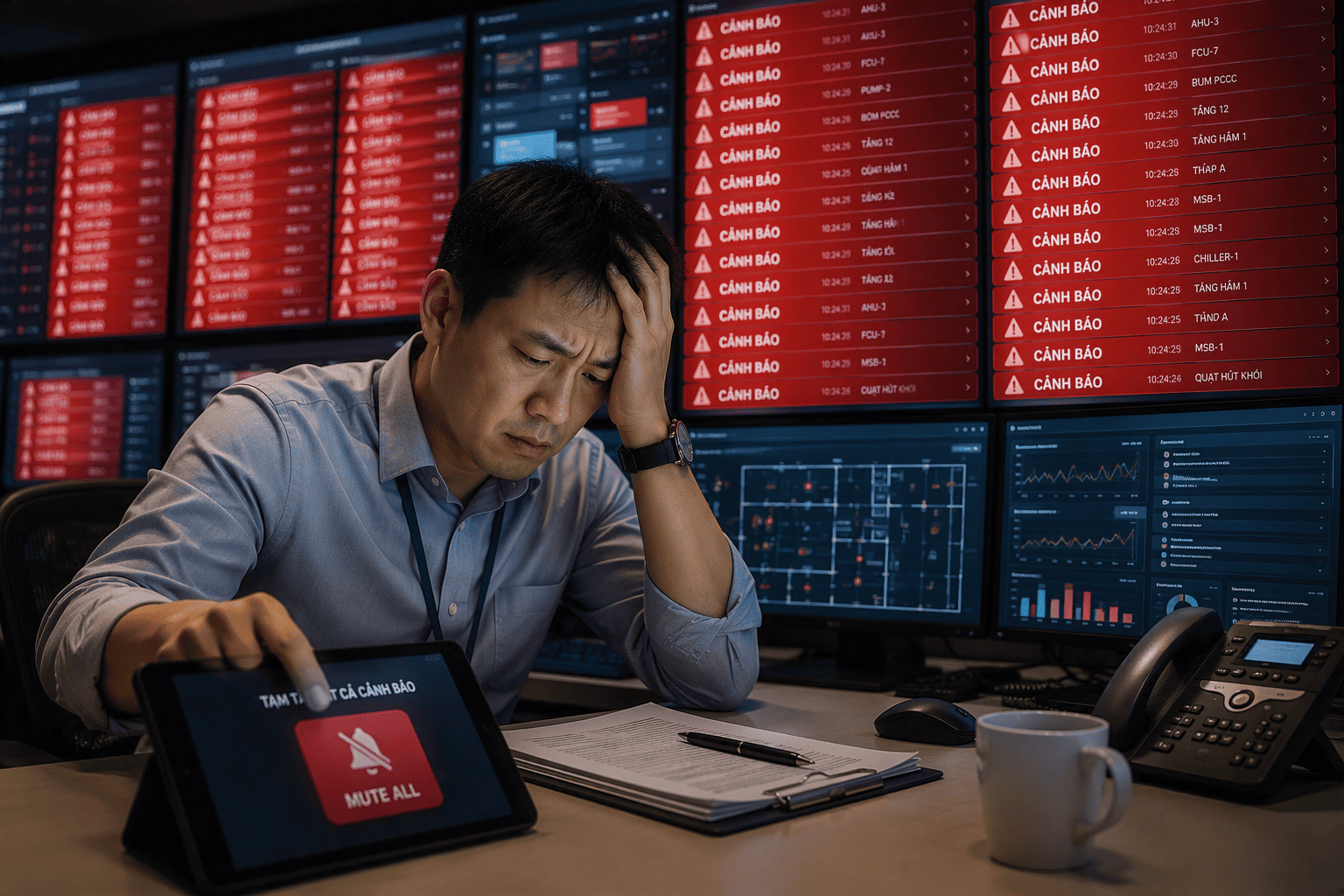
When the warning system issues too many alerts, nobody wants to listen anymore.
Imagine a Facility Manager starting their workday with over 200 alert notifications from the BMS, electrical, HVAC, and IoT systems.
Initially, all warnings were carefully checked.
But after a few weeks, when most of the alerts were just normal operating fluctuations, operators began to ignore them.
This is the phenomenon. Alarm Fatigue — one of the common reasons why critical incidents are detected too late.
In reality, the problem doesn't lie with the people.
The problem lies in how the system generates alerts.
What is Alarm Fatigue?
Alarm Fatigue is a state where the operator receives so many alerts that they lose the ability to differentiate them:
- This is a really important warning.
- This warning is for informational purposes only.
- False Alarm
When the number of alerts exceeds the processing capacity, the natural reaction is:
- Tắt thông báo
- Ignore the warning
- See all alerts as the same.
This is the most dangerous time for a construction project.
Why is the BMS system generating so many alerts?
The most common cause stems from the model:
Threshold Alerting
For example:
- Temperature > 26°C → Warning
- Humidity > 65% → Warning
- CO₂ > 800 ppm → Warning
This approach is simple, but it has a problem:
The system does not understand the operating context.
For example:
- 26°C at 2 PM in the summer can be perfectly normal.
- A temperature of 26°C at 2 AM could be an abnormal sign.
However, the system still generates the same type of alert.
The result is:
Hundreds of alerts are generated every day, but most don't require actual action.
What is the difference between Threshold Alerting and Anomaly Detection?
1. Threshold Alerting
Principle:
If the value exceeds the threshold → Warning (Show more lines)
Advantage:
- Easy to deploy
- Low cost
- No historical data required.
Disadvantages:
- Many false alarms
- Lack of understanding of context.
- No unusual trends detected.
2. Anomaly Detection
Principle:
If the data differs significantly from the normal state → Warning. Show more lines.
The system will analyze:
- Historical data
- Time of day
- Day of the week
- Operating conditions
- Device behavior
For example:
Current temperature:
24°CShow more lines
Do not exceed the limit.
But:
- The average temperature over the past 30 days has been 18°C.
- The upward trend continued for 6 hours.
The system immediately flagged this as an anomaly.
Why is Anomaly Detection More Effective?
Anomaly detection doesn't look at a single value.
It looked at:
- Behavior
- Trend
- Correlation
For example:
Một AHU tiêu thụ điện tăng 20%.
Threshold:
No warnings. Show more lines.
vì vẫn nằm trong giới hạn.
Anomaly Detection:
Warning Show more lines
Because this consumption level is unusual compared to that of the same device in the weeks prior.
4 Common Anomaly Detection Technologies
1. Statistical Baseline
Compare current data to historical averages.
Fit:
- Office Buildings
- Hotel
- Shopping Mall
2. Time-Series Forecasting
Forecasting future data based on trends.
Early detection:
- HVAC performance declines
- Chiller malfunction
- The water system is malfunctioning.
3. Machine Learning
Phân tích đồng thời:
- HVAC
- Electricity
- Water
- Environmental conditions
Widely used in:
- Data Center
- Industrial Plants
- Campus lớn
4. Hybrid Alerting
Combine:
- Threshold
- Statistical Baseline
- AI
This is the model recommended by GEEC for most construction projects in Vietnam today.
Mô Hình Cảnh Báo Thông Minh GEEC Khuyến Nghị
Level 1 — Critical
Alerts require immediate response:
- Fire alarm
- Gas leak
- Main power outage
- Safety incident
Sent to:
- Protect
- On-call technician
- Operations management
Level 2 — Operational
Operational warnings:
- AHU malfunction
- Chiller malfunctioning
- The pump is not responding.
Sent to:
- Đội kỹ thuật
Tầng 3 — Informational
Thông tin:
- Electricity consumption trends
- Thiết bị sắp bảo trì
- Báo cáo hiệu suất
Không cần tạo cảnh báo thời gian thực.
Buildings That Should Apply Smart Alerting
Office Buildings
- BMS
- HVAC
- Electricity
- Water
Shopping Mall
- Many guests
- Adult traffic
- Diverse equipment
Hospitality & Resorts
- Operates 24/7
- Customer experience is important.
Factory & Industrial Park
- Continuous device
- High downtime costs
Data Center
- The request was almost trouble-free.
- It is important to detect any abnormalities early.
Implementation Plan for the Project
Step 1
Audit dữ liệu cảnh báo hiện tại.
Step 2
Alert classification:
- Critical
- Operational
- Informational
Step 3
Thu thập dữ liệu lịch sử tối thiểu:
30 ngàyShow more lines
Step 4
Triển khai mô hình Smart Alerting.
Step 5
Track KPIs:
- False Alarm Rate
- Response Time
- Response Rate
Perspective from GEEC
Một hệ thống cảnh báo tốt không phải là hệ thống tạo nhiều cảnh báo nhất.
It's a system:
- Đúng thời điểm
- The right person
- Correct priority level
When the Facility Manager trusts the system's alerts, operational efficiency will change completely.
That is the real goal of Smart Building.
GEEC Support
- Existing Marine BMS system
- Smart Alerting Design
- BMS Integration · IoT · Dashboard
- Analyzing anomaly alerts
- HVAC Analytics
- Predictive Maintenance
- Panasonic Fire Alarm Integration
📞 Hotline: 079.861.9999
📧 Email: info@geec.vn
🌐 Website: www.geec.vn