
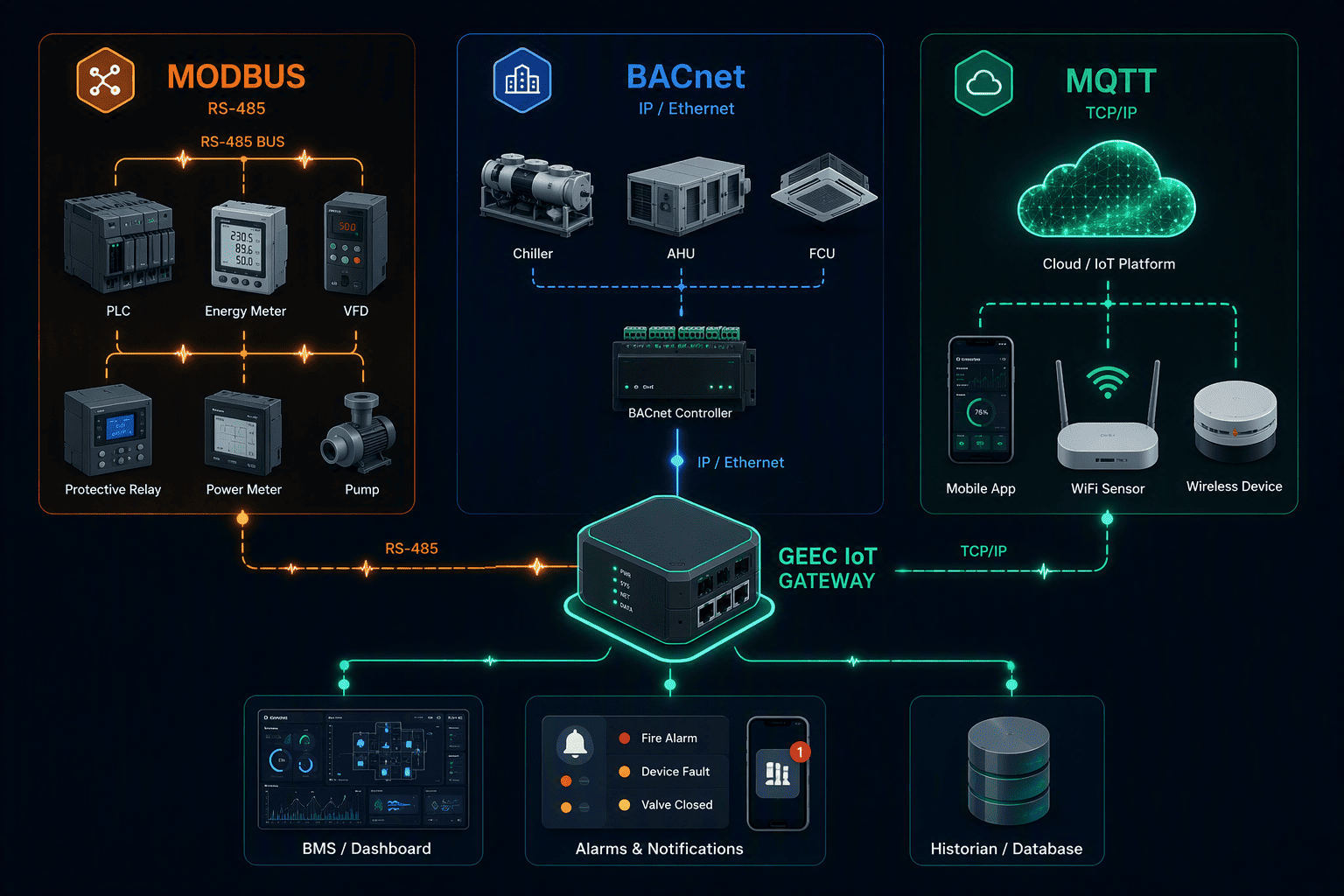
The contractor suggested Modbus. The client listened to the BMS consultant and recommended BACnet. The IT team wanted MQTT in the cloud. Three people, three protocols, one project — and no one explained why. This guide analyzes the practical technical aspects and provides a decision framework to help you choose correctly the first time, not after installation when you discover incompatibility issues.
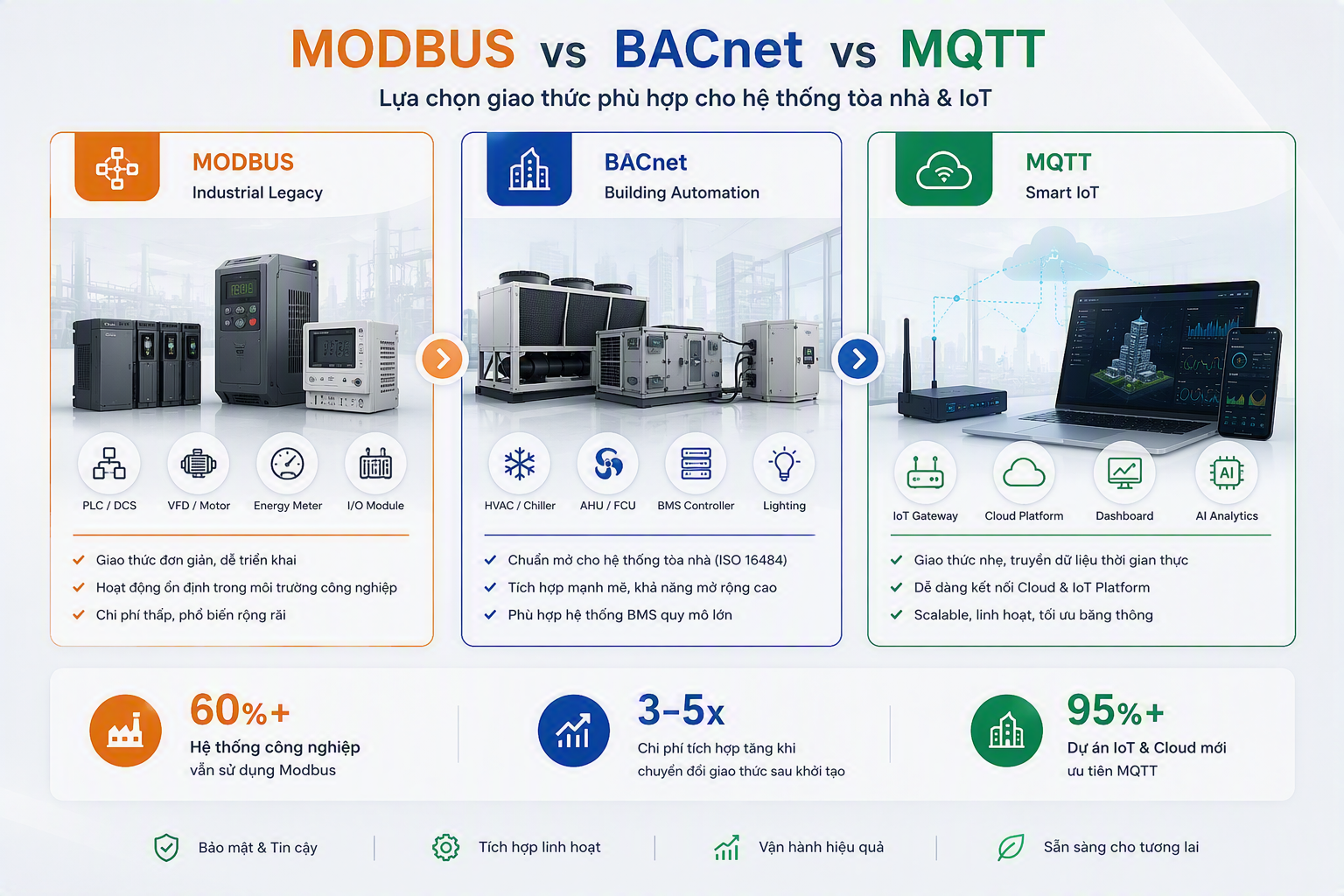
Decision Tree — Find the appropriate protocol for 4 questions
Answer the four questions below to receive recommendations for the right protocol for your project. No registration or app download required:
Technical analysis: Modbus — the protocol of “what works”
Modbus was designed in 1979 by Modicon for industrial PLCs — and is still here in 2026 because it solves a simple problem extremely effectively: reading and writing registers from industrial devices over inexpensive RS-485 cables. The structure is simple — each request is device address + function code + register address + number of registers — No negotiation needed, no complicated handshake required.
Modbus's biggest strength is The device offers an unimaginable level of support.: Electric meters from Schneider, Eastron, Carlo Gavazzi; VFDs (variable frequency drives) from ABB, Siemens, Danfoss; PLCs from Mitsubishi, Omron, Siemens S7. In Vietnam, if industrial equipment has RS-485, it almost certainly uses Modbus RTU.
Important Modbus limitations you need to know
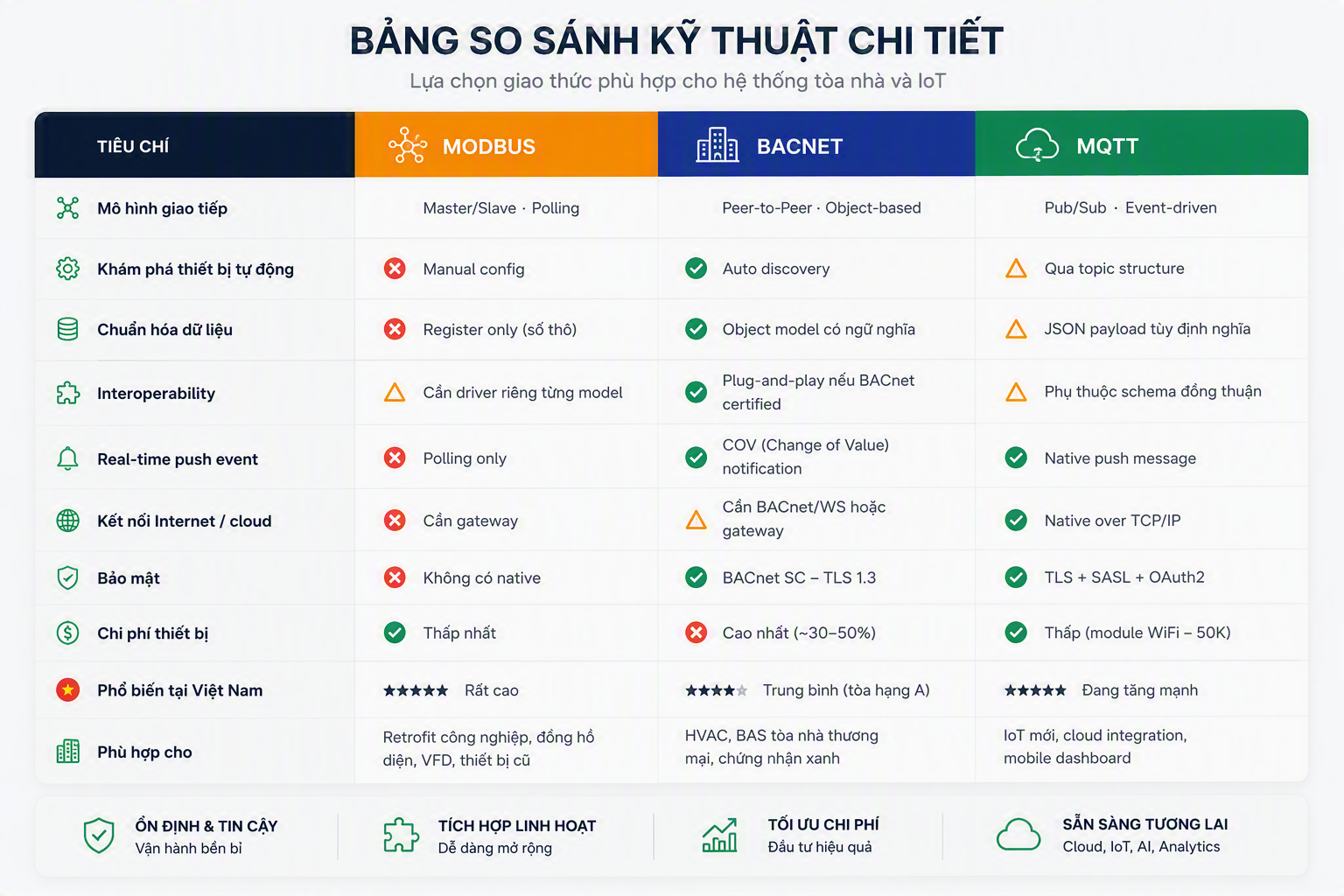
Polling models cause lag: The master must query each slave sequentially — with 50 devices, each querying every 100ms, the cycle to read all 50 devices takes 5 seconds. This is not suitable for data that needs to be real-time (<1 second). No event-driven: Slaves cannot "push" alerts themselves — masters must poll. Không có bảo mật native: In an Ethernet environment, Modbus TCP is vulnerable to packet injection if not protected by a firewall.
BACnet — the language of professional commercial buildings
BACnet (Building Automation and Control Networks) was developed by ASHRAE specifically for building automation—not general industrial automation, but for HVAC, lighting, access control, and fire protection systems in commercial buildings. The core difference from Modbus: BACnet uses a model... object model — Instead of reading the numbers from register, you read the properties of an “object” that have a clear semantic meaning.
For example, Modbus tells you the value at register 40001 = 2563 — You have to check the manual to find out that the temperature is 25.63°C. BACnet will tell you. Analog Input Object "Zone Temperature" = 25.63°C With the unit, description, and alarm threshold embedded within the object, BACnet allows integration of devices from various manufacturers without needing to write separate drivers for each model.
BACnet/IP vs. BACnet MS/TP — which one to choose?
BACnet/IP (via Ethernet): High speed, connects to existing IT network, suitable for BMS servers and SCADA systems. Most common in new buildings. BACnet MS/TP (via RS-485): For older DDC controllers and field devices. Lower speed but lower cabling costs. In practice: most projects use this. cả hai MS/TP is at the field level, BACnet/IP is at the integration layer.
MQTT — the protocol of the IoT and cloud era
MQTT (Message Queuing Telemetry Transport) was designed for low-bandwidth, low-reliability environments—originally used for satellite-based sensing on oil pipelines. Today, it is the world's most popular IoT protocol for one reason: Publish/subscribe models via a central broker..
Instead of device A needing to know the IP address of device B (like Modbus and BACnet), an MQTT device only needs to publish to the broker with a topic.building/floor3/hvac/temperature). Every subscriber interested in that topic will receive a message immediately — whether the subscriber is a dashboard, cloud analytics, or mobile app. This is why MQTT scales so well: adding thousands of consumers without any device-side changes.
MQTT broker — self-hosted or managed cloud?
Self-hosted (Mosquitto / EMQX): Data is local, not internet-dependent, and has low latency. Recommended for buildings requiring data compliance. Cost: server ~5–15 million VND/month. Managed cloud (AWS IoT / Azure IoT Hub): Unlimited scalability, no operations team required, built-in AI/analytics integration. Suitable for dashboards across multiple buildings on a single platform. Note data storage regulations in Vietnam (Decree 13/2023/ND-CP).
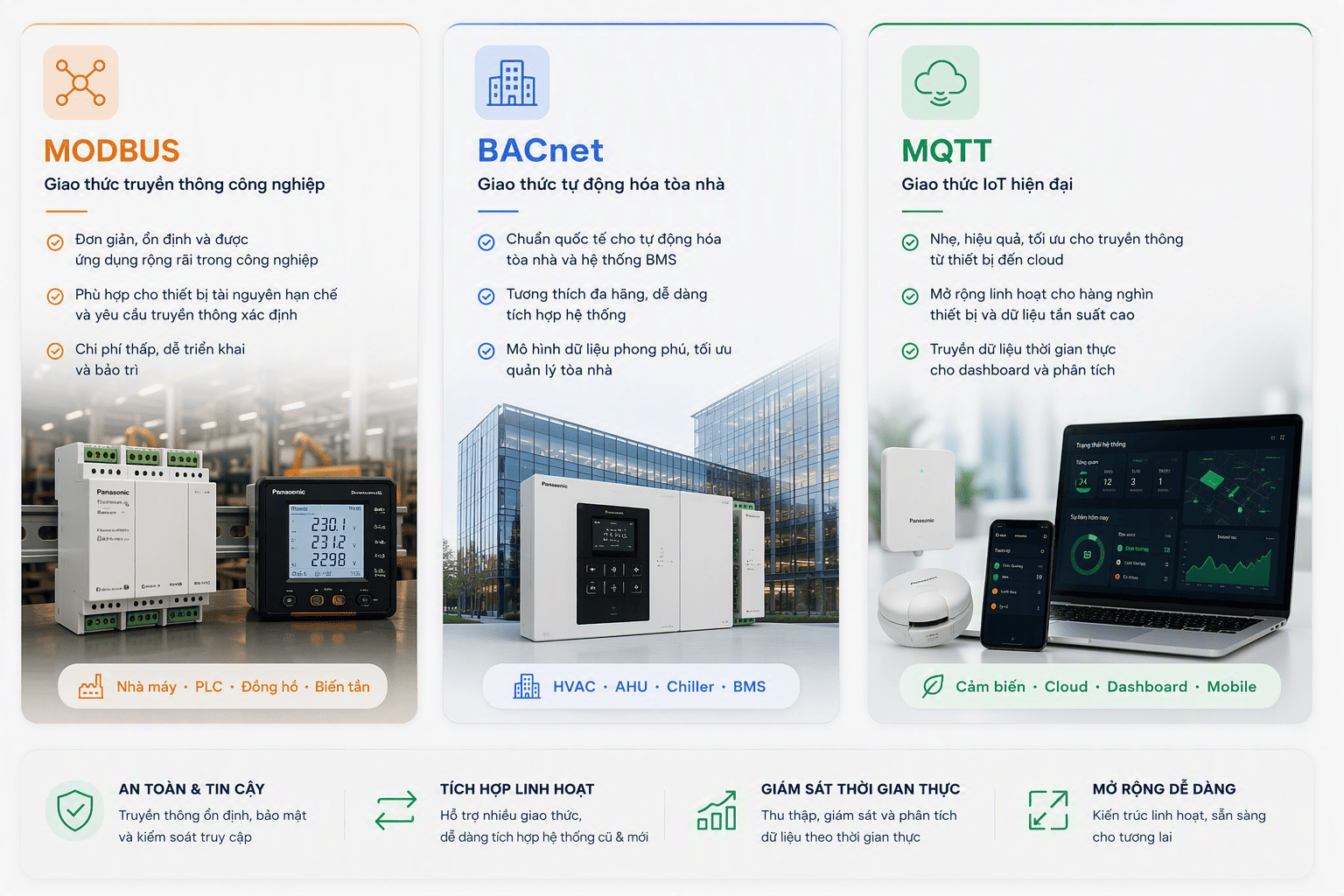
Typical applications — who uses what and why
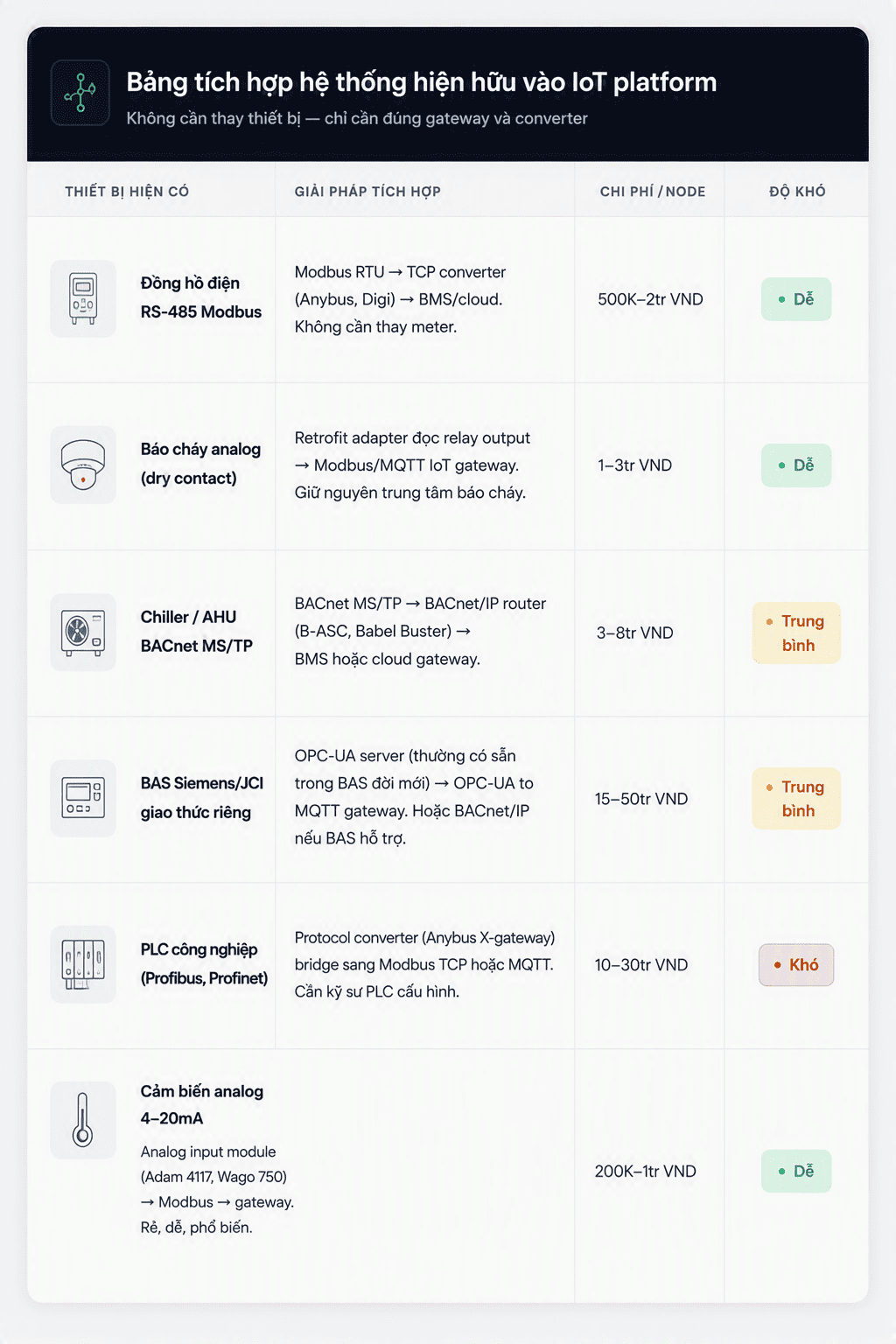
The legacy system integration roadmap — don't break, add.
Câu hỏi thực tế nhất: tôi đang có hệ thống cũ, tôi muốn thêm IoT giám sát mà không thay thiết bị hiện hữu. Đây là bảng tham chiếu nhanh:
The reality of the Vietnamese market in 2026 — who is using what?
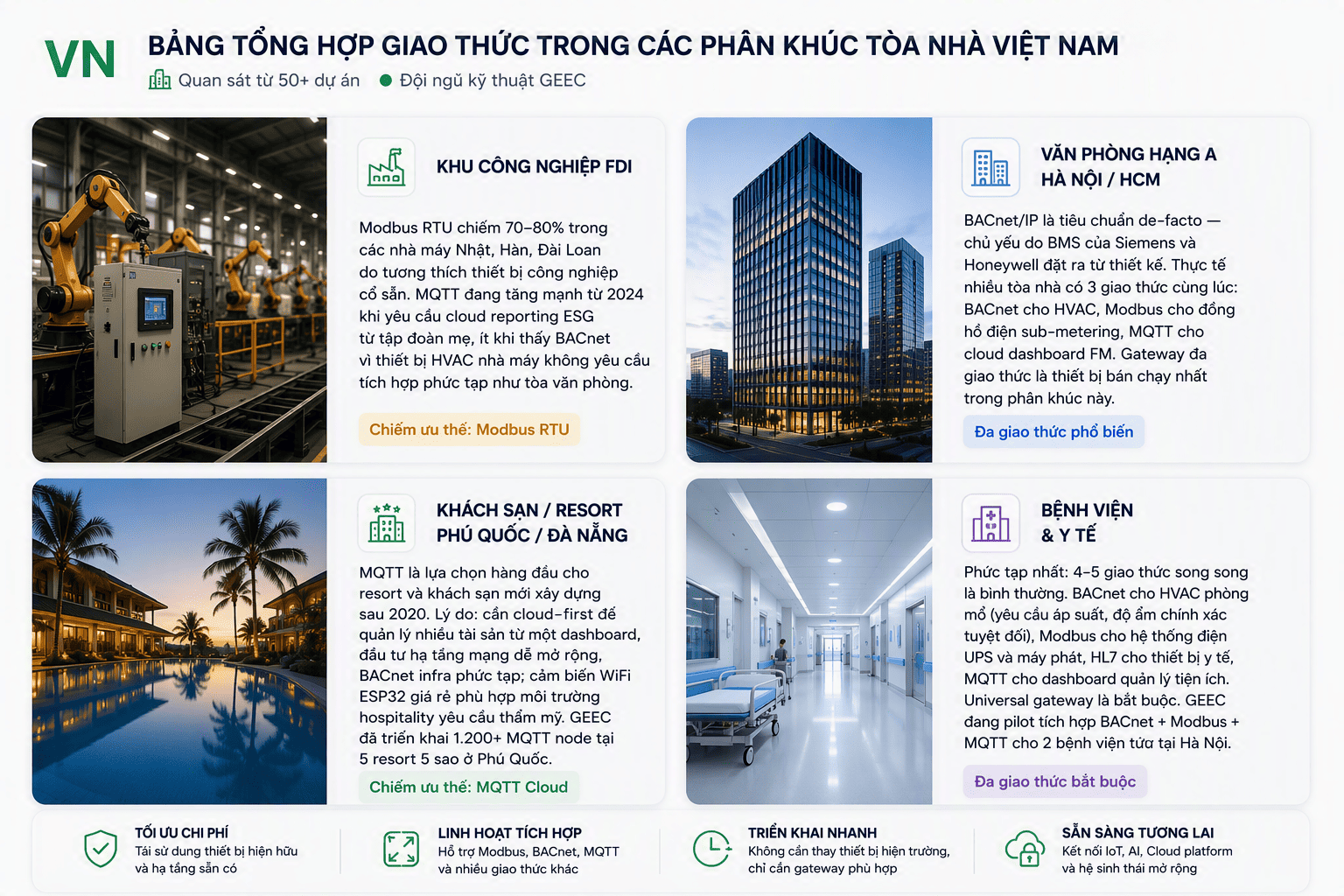
Practical recommendations from GEEC
Don't try to choose a single protocol for the entire building — that's the wrong way to think. The right way to think: Choose a gateway robust enough to communicate with all protocols, and standardize to a single data platform at the top layer.A universal IoT gateway (Anybus, Digi, or a custom Raspberry Pi with pymodbus + bacpypes + MQTT paho library) is the heart of every practical integration project. And this is the product/service that GEEC specializes in providing to the Vietnamese market.