
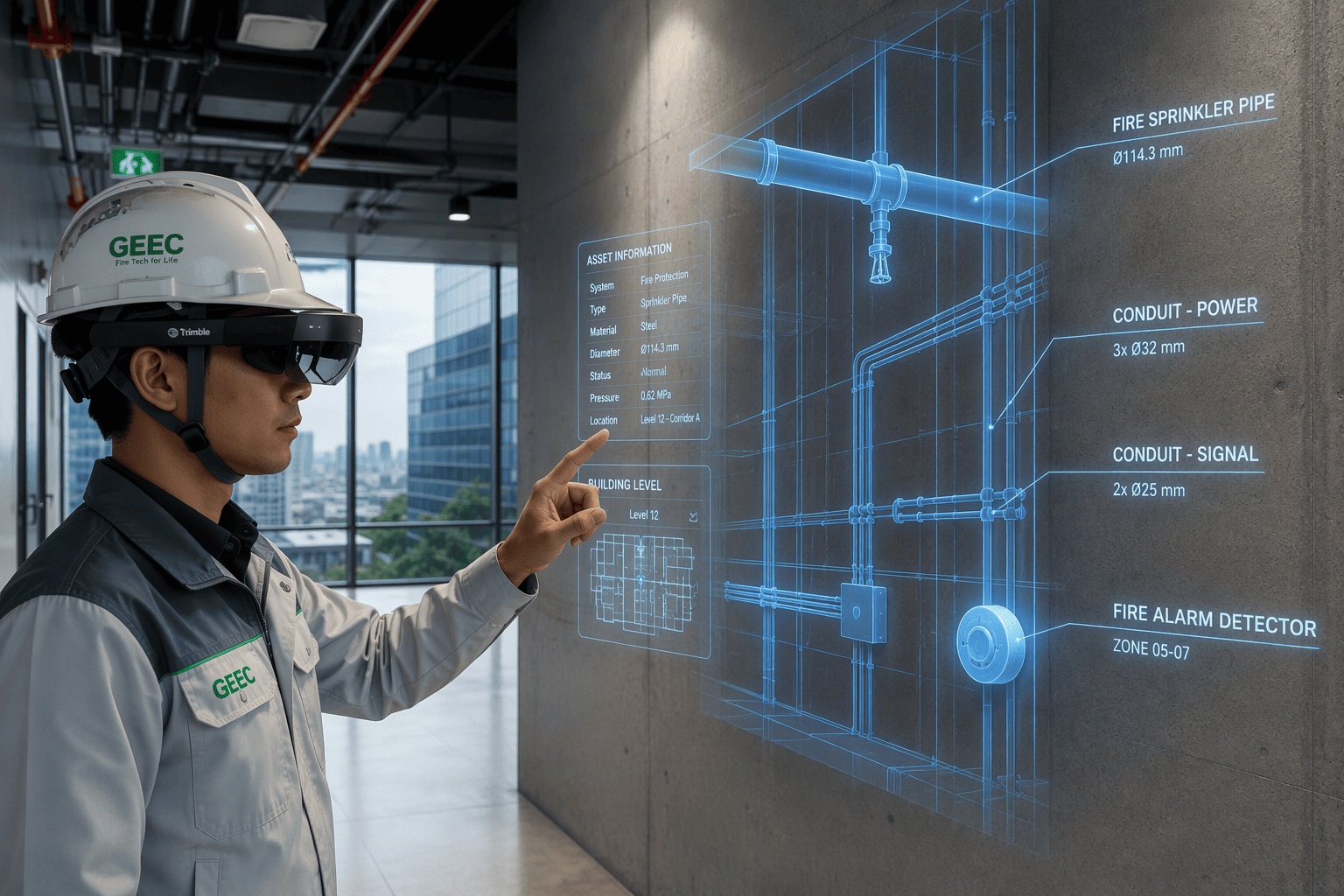
In the context of the ongoing digital transformation in the construction and building operation management industry, technology. AR (Augmented Reality) và VR (Virtual Reality) They are gradually appearing in technical maintenance activities.
For the field phòng cháy chữa cháy (PCCC)AR/VR is no longer a technology for demonstration or experimentation. It is becoming an effective tool to support:
- Fire alarm system maintenance
- Inspect fire safety equipment.
- Personnel training
- Emergency situation simulation
- Construction engineering data management
However, the question is:
What real value do AR/VR bring to fire protection maintenance?
And are investors, building managers, or factory owners in Vietnam ready to adopt this technology?
What are AR and VR?
AR – Augmented Reality
AR is an augmented reality technology that allows digital information to be layered onto a real-world environment.
Through:
- Smart glasses
- Phone
- Tablet
Users can see:
- Fire detector location
- Sprinkler pipeline
- Signal cable
- Device information
- Operating status
Right in the real-life image before our eyes.
VR – Virtual Reality
VR is a virtual reality technology that creates a complete simulated environment.
The user will:
- Wear VR glasses.
- Interacting with the digital environment
- Practice technical procedures.
- Situational training
without affecting the actual system.
Why Does the Fire Protection Industry Need AR/VR?
Maintaining traditional fire protection systems often presents the following challenges:
- The completion documents are incomplete.
- Missing updated drawings
- Difficult to locate the device
- Mất nhiều thời gian kiểm tra hiện trường
- Personnel training relies on practical experience.
As projects grow in scale and the number of pieces of equipment increases, traditional methods begin to reveal their limitations.
AR/VR helps to solve these problems precisely.
5 AR/VR Applications That Bring Practical Value to Fire Protection
1. Faster Device Location
Through BIM or Digital Twin models integrated with AR, technicians can:
- Locate the detector.
- Find the signal cable route.
- Identify the sprinkler valve.
- Identify the control cabinet.
Right at the scene.
No need:
- Find the paper drawings
- Compare multiple records
This is especially effective with:
- Hospital
- Shopping Mall
- Industrial Plants
- Large office building
2. Remote Technical Support
On-site technicians can use AR to share live images with experts.
Support engineers can:
- Mark the location of the error.
- Define the area that needs to be inspected.
- Display instructions directly on the operator's screen.
Help:
- Reduce processing time.
- Reduce travel costs.
- Improve the effectiveness of technical support.
3. VR Operator Training
VR creates a simulated environment:
- Fire in the technical room
- Warehouse fire
- Office building fire
- Escape situation
Learners get hands-on practice:
- Activate the fire alarm.
- Handling alerts
- Evacuation Coordination
- Emergency response
without affecting actual operations.
4. Risk Simulation and Assessment
Combining Digital Twin and VR allows:
- Check the coverage area of the news headline.
- Check the smoke extraction system.
- Assess the escape route.
- Fire development simulation
before the actual incident occurs.
5. Standardize Maintenance Records
AR can be combined with:
- QR Code
- NFC
- CMMS
- Mobile Maintenance App
to:
- Record device status
- Create a maintenance log
- Synchronize data to the Cloud
- Track operating history
This helps to significantly reduce errors in the manual record-keeping process.
Can AR/VR Replace Technicians?
The answer is:
Are not.
AR and VR are merely supporting tools.
The following activities still require technical expertise:
- Incident assessment
- Test the system.
- Commissioning
- Testing & Commissioning
- Operational decision-making
The value of AR/VR lies in the fact that:
It helps technicians make faster and more accurate decisions.
Which types of projects should utilize AR/VR?
High priority
- Shopping Mall
- Hospital
- Hotel
- Resort
- Class A office building
- Data Center
Very suitable
- Manufacturing & Industrial Sector
- manufacturing plant
- Stock logistics
- Technical infrastructure station
It can be implemented in stages.
- School
- Apartment
- Administrative agency
Real-World AR/VR Application Roadmap
Phase 1
Digitizing technical documents
- BIM
- Digital Twin
- Asset Database
Phase 2
AR supports field maintenance.
- Tablet AR
- Mobile AR
- QR Asset Tracking
Phase 3
VR for employee training
- Fire Protection
- Escaped danger
- Troubleshooting
Phase 4
IoT Connectivity · BMS · Dashboard
- Real-time Monitoring
- Predictive Maintenance
- Smart Operations
Perspective from GEEC
Over the next five years, AR/VR technology will not replace traditional fire safety techniques.
But units that adopt it early will have a distinct advantage in terms of:
- Problem resolution speed
- Maintenance quality
- Personnel training
- Operational data management
- Digital transformation of construction projects
For new constructions, especially:
- Industrial Plants
- Office Buildings
- Shopping Mall
- Hospitality & Resorts
system design BIM → BMS → Digital Twin → AR/VR This will create a foundation for efficient long-term operation.
Conclude
AR/VR is no longer a technology of the future.
In the field of fire prevention and control, this is becoming a tool that helps:
- Reduce maintenance time.
- Increase technical accuracy
- Standardize operational data.
- More effective employee training
- Enhancing construction safety
For modern investors and management companies, this is a significant step forward in the journey towards building a smart operating model.
GEEC Support
- Consulting on smart fire protection solutions.
- Panasonic Fire Alarm
- BMS · Dashboard · IoT
- BIM & Digital Twin
- Fire protection system maintenance
- Technical operation training
📞 Hotline: 079.861.9999
📧 Email: info@geec.vn
🌐 Website: www.geec.vn