
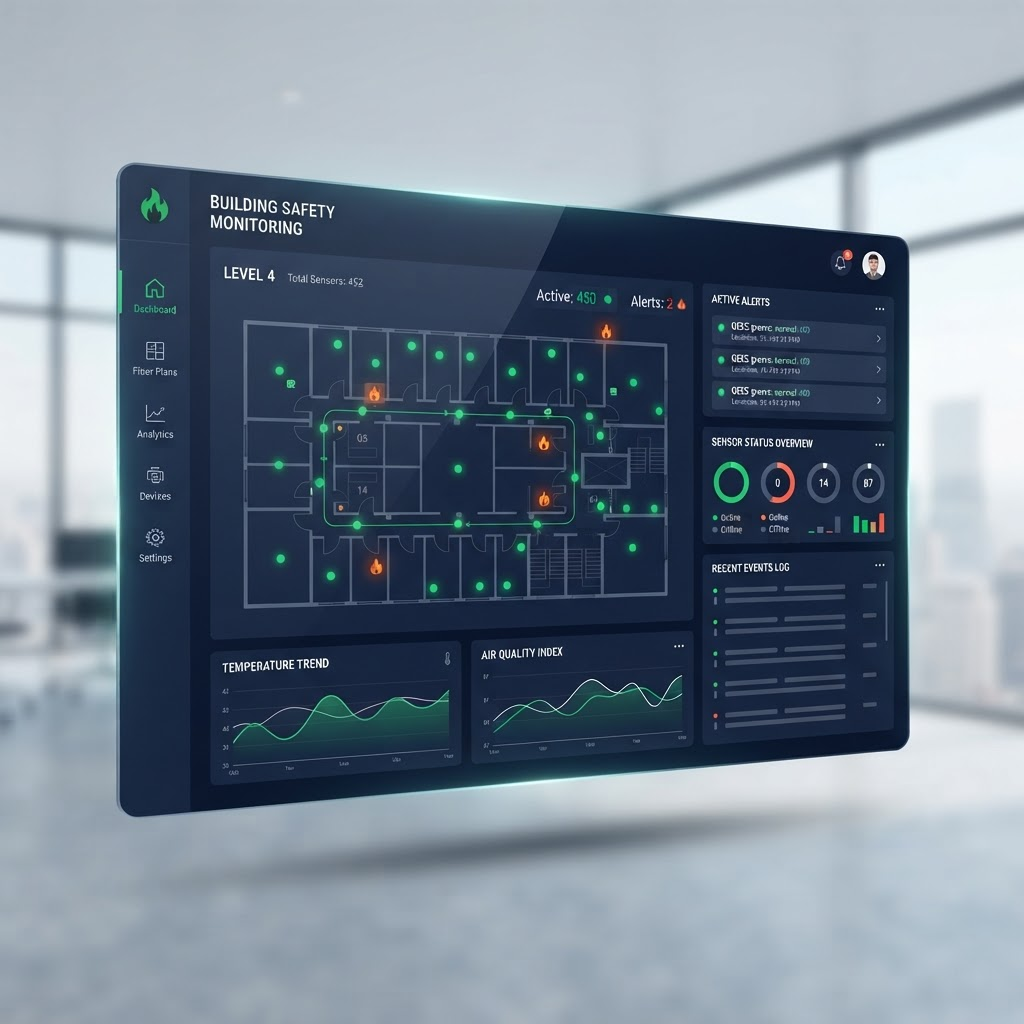
In many current projects, the phrase BMS (Building Management System) It is often used as an "all-inclusive" solution. However, in reality, many projects have invested billions of VND in BMS but still have to use various other software programs to operate after handover.
The cause is not technology.
The reason lies in the fact that xác định sai phạm vi BMS ngay từ giai đoạn thiết kế và đầu tư.
This article will help investors, building management, facility managers, and technical teams understand correctly:
- What is BMS?
- What does BMS actually do?
- Which systems need integration?
- Which systems are not within the scope of BMS?
- 11 minimum required items
- How to assess whether a BMS system is functioning correctly.
What is BMS?
BMS (Building Management System) It is a system for centrally managing and controlling mechanical and electrical (M&E) systems in a building in real time.
Unlike platforms that only display data, BMS has the capability to:
✅ Data collection
✅ Analyze device status
✅ Automatic control
✅ Activate the operational logic
✅ Incident alert
✅ Saves activity history
In other words:
BMS is the operational brain of the building.
The Difference Between BMS and Monitoring Systems
Many people confuse:
- Monitoring dashboard
- IoT Platform
- Energy Monitoring
- BMS
The most important difference is:
| Function | Monitoring | BMS |
|---|---|---|
| Read data | ✅ | ✅ |
| Display Dashboard | ✅ | ✅ |
| Operational warning | ✅ | ✅ |
| Device control | ❌ | ✅ |
| Logic Automation | ❌ | ✅ |
| Sequence Management | ❌ | ✅ |
If a system can only read data but cannot control the devices, it cannot be called a complete BMS system.
What value does BMS bring?
1. Operational Automation
BMS helps:
- Automatic HVAC on/off
- Adjust the temperature
- Adjust humidity
- Scheduling equipment
Significantly reduces manual tasks for the operations team.
2. Reduce Power Consumption
Normally:
- HVAC accounts for 40–60% of a building's total electricity consumption.
BMS helps:
- Optimize cooling load
- Chiller control
- Alternate pumping
- Lighting control
This will reduce annual OPEX costs.
3. Centralized Monitoring
FM can be tracked:
- HVAC
- Electricity
- Water
- Illumination
- Auxiliary systems
on the same platform.
4. Enhancing Reliability
Automatic detection system:
- Power outage
- Overloaded
- Faulty device
- Operational warning
before affecting the user.
The Correct Scope of BMS
This is the most important part of the entire article.
The systems SHOULD be located within the BMS.
HVAC
Include:
- Chiller
- Cooling Tower
- AHU
- FCU
- VAV
- Cold water pump
- Condensate pump
This is the most important component of any BMS system.
Electricity
The BMS should monitor:
- Transformer
- MSB
- MDB
- ATS
- Generator
- UPS
And the parameters:
- kWh
- kW
- PF
- Voltage
- Current
Water System
- Booster pump
- Water supply pump
- Drainage pump
- Rooftop pool
- Underground tank
Common Area Lighting
Include:
- Lobby
- Lobby
- Parking lot
- Public area
Scheduling theo:
- Operating hours
- Presence sensor
- Holiday
Ventilation
- Turbocharger
- Smoke extraction
- Basement ventilation
These systems should NOT be controlled directly via the BMS.
Fire Alarm System
A BMS should only:
✅ Read status
✅ Receive alert signals
✅ Activate HVAC interlock
Không nên:
❌ Firefighting logic control
❌ Replace Fire Alarm Controller
CCTV
BMS is not a system:
- Camera
- NVR
- Video Analytics
State integration only.
Access Control
BMS is not a replacement for:
- Door lock controller
- User management
- Access card
CMMS
BMS is not a replacement for:
- Maintenance management
- Work Order
- Spare Parts
That is the role of CMMS.
4 Essential Items That Must Be Included
A proper BMS must have at least:
1. HVAC Control
2. Electrical Monitoring
3. Lighting Scheduling
4. Water System Monitoring
If any of these four groups are missing, the operational value of the BMS will decrease significantly.
11 Items to Check in a BMS System
Quick Review Checklist
✅ HVAC Control
✅ Rotation Chiller
✅ Rotation Pump
✅ Scheduling Lighting
✅ Water Monitoring
✅ Electrical Metering
✅ HVAC – Fire Interlock
✅ Historical Trend
✅ Remote Access
✅ Audit Trail
✅ Naming Convention Chuẩn
If three or more items are missing, the system should be audited and re-evaluated.
Common Mistakes When Investing in BMS
No Sequence of Operation
The system is running, but nobody knows the logic behind it.
No Standard I/O List
Rất khó bảo trì và mở rộng.
Không Commissioning Đầy Đủ
The device is working, but its performance is low.
No Audit Trail
Difficult to determine:
- Ai thay đổi
- Thời điểm thay đổi
- Parameters change
Không Có Mobile Access
FM has to go to the control room every time it needs to be checked
When Should You Upgrade Your BMS?
You should consider upgrading when:
- Building expansion
- Thay đổi công năng
- Increase the number of tenants
- Tích hợp ESG
- IoT integration
- Integrated multi-building dashboard
- BMS is no longer supported.
Conclude
BMS is not a dashboard screen.
BMS is a platform for controlling and automating the electromechanical systems of a building.
A properly designed BMS system will help:
- Reduce operating costs.
- Increase system stability
- Enhance the user experience.
- Supporting Facility Managers in making better decisions.
- Laying the foundation for the future of IoT and Smart Building.
What support does GEEC provide for the BMS project?
- Existing Marine BMS system
- Consulting services for Building Management System design.
- Integrated HVAC · Electrical · Plumbing · Fire Protection
- IoT · Dashboard · Smart Building
- Commissioning & Operational Training
- System maintenance and upgrades
📞 Hotline: 079.861.9999
📧 Email: info@geec.vn
🌐 Website: www.geec.vn